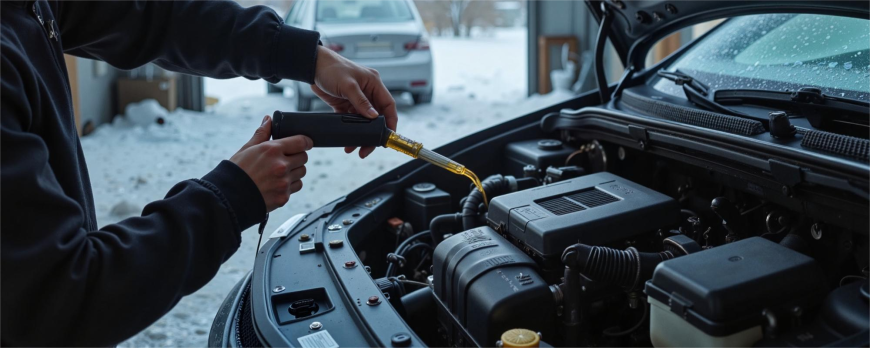

Winter Oil: Why the Calendar Matters More Than the Odometer
We all know the “3,000-mile” rule is largely a thing of the past, but in Wisconsin, the “10,000-mile” rule is equally dangerous. During a Brodhead winter, your engine faces “Severe Duty” conditions. If your daily commute is less than 10 miles, your oil never reaches its optimal operating temperature. This leads to moisture buildup, acid formation, and engine sludge.
The Science of Cold Flow (Viscosity)
Think of oil like syrup. In the fridge, it’s thick and slow. In the microwave, it’s thin.
- The Dry Start: When you start your car at -10°F, conventional 5W-30 oil can take up to 45 seconds to reach the top of the engine (the valve train). For those 45 seconds, metal is rubbing against metal.
- The Synthetic Advantage: Full synthetic oil (like 0W-20) is engineered to flow almost instantly at sub-zero temperatures, providing immediate protection to your bearings and cam lobes
The “Milkshake” Problem: Condensation
When an engine runs, it creates water vapor as a byproduct of combustion. In the summer, this water evaporates. In a Wisconsin winter, if you only drive short distances, that water stays in the oil. It mixes with the oil to create a “milky” sludge that can clog oil passages and cause catastrophic engine failure.
Our Recommended Interval for Wisconsin
At Blizard Auto Repair, we recommend a 5,000-mile oil change interval during the winter months, especially if you do a lot of city driving or short trips. This ensures that contaminants are flushed out before they can cause permanent wear.
Safety First: We always perform a multi-point inspection with every oil change. We check your belts and hoses—which become brittle and prone to snapping in the cold—to ensure you don’t end up on the side of the road with a broken serpentine belt.
FAQ: Winter Oil Changes
Is synthetic oil really worth it in winter? Absolutely. Synthetic oil’s ability to flow in the cold reduces “startup wear,” which accounts for about 75% of all engine wear over a vehicle’s life.
My car says it has 20% oil life left; can I wait? The “Oil Life Monitor” in your car is an algorithm, not a sensor. It doesn’t know if you’re driving in 70-degree weather or -20-degree weather. In Wisconsin, we suggest changing it when it hits 15-20% to be safe.
What happens if I skip an oil change in the winter? Moisture and unburned fuel will dilute the oil, reducing its ability to lubricate. Over time, this leads to “sludge” that can ruin variable valve timing (VVT) systems.
Can I switch back to conventional oil after using synthetic? Yes, that is a common myth. You can switch back and forth, but you will lose the superior cold-weather protection of the synthetic blend.
Does a cold engine use more oil? Not necessarily, but it may “produce” more volume because of fuel dilution (gasoline seeping into the oil pan), which is a sign you need an oil change immediately.