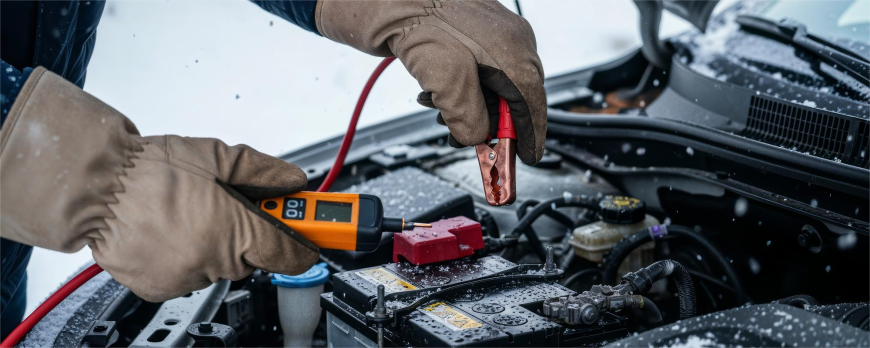

Why Wisconsin Winters Are “Battery Killers”
It’s a scientific fact: car batteries hate the cold. While we often see batteries fail in the winter, the damage actually starts during our humid Wisconsin summers. Heat causes the liquid electrolyte inside the battery to evaporate. When winter arrives, that weakened battery is asked to do twice the work.
The Science of Cold Cranking Amps (CCA)
A car battery relies on a chemical reaction between lead and sulfuric acid to produce electrons. In sub-zero temperatures, this reaction slows down significantly. At 32°F, a battery loses about 20% of its power. At 0°F, it loses 50%.
Simultaneously, the oil in your engine becomes thick like molasses in the cold. This means your battery has half the power to move an engine that is twice as hard to turn. This is why we prioritize the CCA (Cold Cranking Amps) rating when we install a new battery at Blizard Auto Repair.
Signs Your Battery Is On Its Last Legs
- The “Slow Crank”: If the engine sounds like it’s struggling to “grunt” to life, your battery’s internal resistance is too high.
- Case Swelling: If the sides of your battery look bloated, it has likely frozen. A discharged battery is mostly water, and water expands when it freezes, often ruining the internal plates.
- Acid Corrosion: That white, powdery substance on the terminals (lead sulfate) creates high resistance, preventing the alternator from fully charging the battery.
Pro-Tip: The “Parasitic Draw”
Modern cars never truly “turn off.” Your keyless entry, clock, and alarm system all pull a tiny amount of power. In extreme cold, even a tiny “parasitic draw” can drain a weak battery overnight. We recommend a battery tender if you aren’t driving your vehicle every day during a Brodhead winter.
Frequently Asked Questions (FAQ)
Why is my check engine light flashing? A flashing check engine light indicates a severe engine misfire. This means unburned fuel is entering the exhaust system, which can quickly overheat and destroy your catalytic converter. You should stop driving immediately and have the vehicle towed to Blizard Auto Repair to avoid thousands of dollars in damage.
How can I tell if my battery or starter is bad? If you turn the key and hear a rapid clicking, it is usually a weak battery or poor connection. If you hear a single loud “clunk” but the engine doesn’t turn, the starter motor is likely the culprit. At Blizard, we perform a voltage drop test to pinpoint the failure.
Can a cold battery be recharged? Yes, but only if it hasn’t frozen. A fully charged battery won’t freeze until -76°F, but a dead battery can freeze at 32°F. If the battery case is bulging or cracked, it must be replaced. Never attempt to jump-start or charge a frozen battery, as it can explode.
Does 4WD or AWD use more gas in the winter? Yes. Engaging four-wheel drive creates more mechanical friction because the engine must turn extra driveshafts and gears. Additionally, the extra weight of AWD systems contributes to the 10-20% drop in fuel economy typically seen during Wisconsin’s winter months.
Is it safe to drive with the check engine light on? If the light is steady (not flashing) and the car feels normal, you can usually drive it to a shop. However, ignoring it can lead to decreased fuel economy and the failure of other components, like the oxygen sensors or the catalytic converter, leading to much higher repair costs later.